
Castles: Dismissal and Regrets (Life along the Borders)
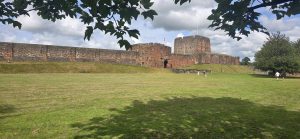
Looking back over my life I have come to realize how often I dismiss something out of hand and in retrospect I realize how I have come to regret it. Travel, especially writing about it, requires an open mind. So, I need to make a confession; I find castles boring and choose to skip over them while travelling.
Perhaps this feeling is the result of teaching Ancient and Medieval history to high school students for decades. Boys really get into castles. Maybe this fascination is somehow Freudian as castles do project a type of power onto a landscape. To be fair, monarchs and the nobility spent considerable time and energy on castle building. Kings and queens were always aware if one of their nobles was trying to outdo them in terms of castles.
The city of Carlisle has had a castle since Roman times. It has been the most besieged castle in England. The construction of the castle that one sees today began in the 12th century during the reigns of Henry 1 and II and David I (Scotland). It has played a significant role during the Scottish wars of Independence and the English Civil War. During the 1500’s, the English imprisoned Mary, Queen of Scots. The castle was also the administrative centre of The Lord Warden of the West March whose primary role involved the keeping the peace amongst the Border reivers.
Dismissal
This summer I was in Carlisle and had a chance to check out the castle, and as my confession above reveals, I chose not to. First, due to the tiredness from my overnight flight. On the second day having hiked from Bowness on Solway back to Carlisle I arrived with only 30 minutes left until closing. Here is where my anti-castle bias emerged. I decided to skip it, well because I have seen dozens of castles, so this is not big deal. Cue the regret button.
Regret
Back in Canada I am starting to write and research facts about the Scottish borderlands. My first regret of my anti-castle bias was realizing that the Bell family lived less than 30km from the Carlisle castle which was the seat of English power in the west March, and the place where decisions would be made that had a direct impact on their lives, living across the border in Scotland. The “Rough Wooing” period (1543-1551) when the English adopted a scorched earth policy along the Scottish side of the border would have been not something to easily forget. The destruction of the Blanket tower in 1547, the symbol of Bell power, would be a concrete reminder of the consequences of living so near the Carlisle castle. They likely knew that Mary, Queen of Scots, held there in 1568, and understood that her imprisonment was linked to the turmoil of the “Rough Wooing.” So, the significance of the castle in Carlisle on their lives can not be understated.
Suddenly my ambivalence for castles, at least for this castle, was disappearing. But so far, the connection to this castle has been one sided. From this castle the English inflicted violence on the Sottish side of the West March. But in the end, I uncovered a comeuppance-the storming of the castle by a group of Scottish reivers in 1596 to free Willie “Kinmount” Armstrong. This event became a major diplomatic incident and immortalized by the Scottish poet and author Sir Walter Scott. Of the 30 to 40 Scottish reivers involved in this audacious act perhaps not surprisingly four of them had the surname “Bell”.
The Freeing of Willie “Kinmount” Armstrong
Under March Law, there would be “Truce Days” where the wardens of both sides would meet to sort out justice and reparations for any cross border illegal activities that had occurred since the last “Truce Day.” After the meeting, the deputy warden Thomas Salkede detained Willie in violation of the amnesty granted during Truce Days. Although, the reivers were by no means followers of rules, this rule demanded reprisal.
On April 13, 1596, a group of 30 to 40 reivers (the English warden claimed five hundred in his report to the Privy Council) under the leadership of Warden Walter Scott stormed the castle to free Willie. Accompanying Scott, were twenty-four Armstrongs and Elliots, four Bells and five Irvines, all border families of the West and Middle Marches. Even though these families often participated in feuding amongst themselves they did also come together as they did in this case. We know who was involved as a Graham was an anonymous source that snitched to the English Warden Scrope.
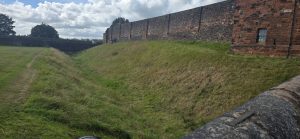
According to the legends surrounding this event, Willie “Redcloak” Bell was responsible for literally carrying Kinmount Willie chains and all out of the castle. After the escape, Kinmount Willie lived freely and died between 1608 and 1611.
So next time I am in Carlisle, I have no excuses to dismiss a visit to the Carlisle Castle.