
From Child to Caregiver

One winter break, while in university, I was working in a long-term care facility painting the newly installed doors to help pay for my education. At the time long-term care facilities were scary for me. But something happened. I got to know the residents, their names, their habits, and my presence became part of their life. I felt less scared and came to enjoy my time there.
When my mother became a resident of long-term care home, a whole new set of emotions came into play. I remember walking down the hall and feeling myself start to try to shift from the world of work driven by my agency and what I saw as “my life” to a different one that was existing on a parallel plane. “My life” felt sharply delineated where I was managing a crew on my farm, maintaining production to feed 150 customers a week as well as restaurants all of which required “doing”. However, when I walked through the care facility doors all those things did not matter.
Leaving the world of agency to one of communion.
The agency I left behind at the door opened to a new world of communion. The word communion, from its Latin secular sense is a “sharing an intimate connection” or “sharing something together.” It was a way to describe a type of human or worldly connection. In the beginning, it was time to sit and share those parts of my life with my mother. As her health begin to decline that sharing began to change. What started off as a sharing of food became a feeding of food. As language became difficult it became a holding of hands while a sharing of silence.
The Epiphany
At mealtime, the residents would gather. It was often as chaotic as a high school cafeteria. The diversity of humanity was fully present as well the diversity of the aging process. Some of the conversations were firmly solitary and based on the past, while others were loud overcoming their hearing differences, some residents were able to feed themselves and while others could not. I would be there to help my mother feed herself. Sometimes six or seven spoonsful would constitute a meal.
It was at that moment that it struck me. Just as my mother had fed me, I was now doing exactly that for her. This cycle of life, the beginning and the end, was not one of agency but one of communion. The part of life that I spent “doing” had now changed to “being.” My success at feeding was irrelevant. To “be” it is only necessary to be present.
The residents, staff and family members who were feeding the residents were all on the same journey. And here is where we often err, thinking that our working lives and all that striving is important, where we fall prey to the idea of success, promotions, and material well being. These things which we achieve are illusionary. All this “doing” really ends up here or somewhere similar, being taken care of.
Surprisingly, this realization brought me a sense of peace. It gave me permission to stop “doing.” Almost overnight, the project of running the farm slipped away in importance. The speed of the identity shift surprised me. Caregiving was my entry in the world of “being”.
In our gendered world, caregiving is the purview of women, as they disproportionately fill the world of jobs in this area. The values of compassion, caring, and patience, are essential skills in caregiving, yet they are undervalued and therefore taken less seriously and paid accordingly. Here we see how the patriarchy distorts the value of what are essential parts of what makes us human, taking care of each other.
Week by week this distortion of what is valuable chipped away. Our society had taught me that caregiving was what women did. From childhood to adulthood, the “curriculum” did in no way prepare me to care give. Changing diapers, learning how to take care of young children, and cooking and so many other things were neither expected of me nor taught as important. Parenthood quickly taught that skill set that was so lacking but I know that the deeply ingrained idea of what was valuable did not change. That lesson was yet to come.
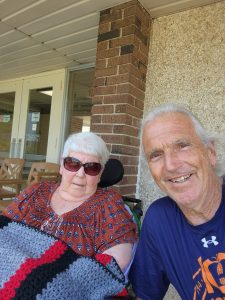
On the outside I existed with a rigid shell of male-based expectations but inside that shell was apparently something entirely different. And in doing so, this turned out to be my mother’s last lesson: I could be a caregiver after all.