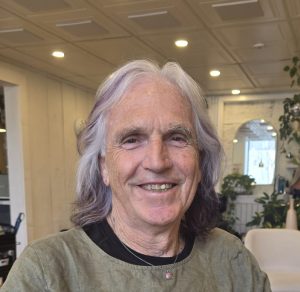
Hair: My journey into gender
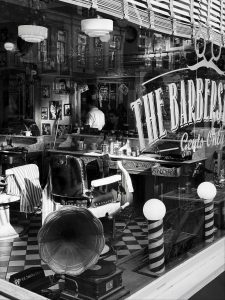
The time was the early 1960’s in Stratford, Ontario and this was a time when neighbourhoods had stores where you could order groceries delivered to your home on bicycles. Supermarkets (is that even a word anymore?) had yet to put local grocery stores out of business. This was also a time when each neighbourhood also had their local barbershops.
I cannot remember my first haircut whether it was at a barbershop or done at home, but I do remember my introduction into the ritual of the local barbershop by my father. This was my first introduction to what I now realize was an exclusively male space. And I remember it.
Blocks away from our home our local barbershop was located at the intersection of two major streets, kitty corner from the local grocery store.
Ed’s Barbershop
The whole experience was a bit of a shock seeing for the first time how male centred spaces operated. A group of guys (reading newspapers) waiting to have their hair cut in near silence. I cannot remember the few conversations I heard, but I do remember they sure did not sound familiar to what I heard at home.
But I do know that this experience held significance as it was my first tacit exposure to a public gender persona. It was a lesson of how guys relate and act. And it became a lesson in independence as I would soon make my journey there by myself on a bicycle.
And I quickly found out there was little choice of what would happen to my hair. To be fair, this was not a time of creative self expression. It felt that we all had the same hair cut.
The Times are a Changing.
Then something changed. The Beatles became a thing and soon I noticed that older kids were starting to sport the styles of the early Beatles. I remember the realization that to adopt that style came with risks, even if I could convince my local barber let alone my family this was an innovative idea.
It is funny looking back, that I intuitively sensed both the risk and the liberation that a hair style could carry even as a 10-year-old in 1967. Hair (especially male hair) was becoming the cultural flash point between conservatives and liberals. Short hair became synonymous to the establishment, while long hair became a symbol of the anti-establishment, rebellion, and protest. Beneath this disagreement about hair styles lay a genuine fear: the risk of being seen as effeminate if someone chose to wear their hair long. This was the risk that policed self expression.
Heading to Female Space
I do not remember what or how I was complaining to my mother about another unhappy haircut, but her suggestion was brilliant, “why don’t you go to my hair salon and try it out.” Decades later, I am still unpacking the absolute audacity of my mother to suggest this solution. This was years before the idea that men could get their hair cut by a woman outside of the home. How I wish I had recorded her conversation preparing me to go to a women’s hair salon. I do remember the warning that “there would be music,” “talking,” and a whole bunch of other stuff that was distinctively female.
The funny thing is that when I started to go to my mother’s salon, it was not a thing-no embarrassment or any teenage angst. For the remainder of my adolescence and into early adulthood my hair cuts occurred in female space, and it was no big deal.
The Pandemic and hair liberation
For my adult years I muddled along with mostly “male” haircuts. Male barbershops, home cuts with Nancy, the franchise shops staffed with mostly women stylists. The Nancy years saw a bit of mullet styling show up.
Under cover of the pandemic whatever hair norms I was following fell by the wayside. With everything shut down the choice was easy. Let it grow out!
I loved the freedom but eventually the vibe of a “guy in ponytail” became as limiting as the male haircuts of my youth and the rigid gender binary that I was finding increasingly uncomfortable.
So, taking a cue from my mother’s audacity, I asked Google the question: “gender affirming hair cuts near me.” I needed to be able to ask for a cut, slightly androgynous leaning toward the femme and that needed a unique and safe space.
Just as the cover of the pandemic opened possibilities to me, an hour away in Guelph, the hair studio Reverie was rethinking their approach. Post pandemic gender-based pricing disappeared and was replaced by a time-based pricing, as was tipping. Environment friendly standards were added as well as a commitment to provide a safe space for LGBTQ2S+ clients.
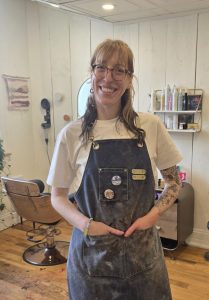
These were substantial changes, but what blew me away was how these changes help to transform the relationship between client and stylist. With time, collaboration is possible, allowing Emma my stylist to have a conversation where listening can occur. With no gender limitations, freeing self expression fifteen minutes later, we had boldly decided for a feathered cut, ditching my reliance on a ponytail, and adding my favourite colour purple, with blacks and browns to harken back to my pre-grey hair days.
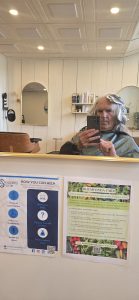
I thought back to the elementary school yard and realized that the gender norms for hair are just constructs of a time and place. I am finally free to choose what I want and have fun at the same time.