
Love of Place: Peter Rabbit and Contributory Love
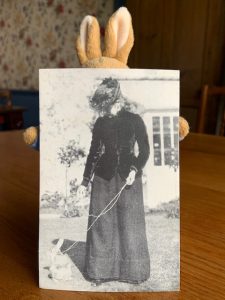
Arriving in the dining room for breakfast, already seated were a couple from the Netherlands, who were also hiking the Cumbria way. I took my seat at a table, only partially awake, to see the tips of two pointy ears staring right back at me holding up an early twentieth century black and white postcard of a woman holding a leash attached to a rabbit. Removing the postcard, I saw that the ears belonged to a rabbit.
After coming from Liverpool where I witnessed the participants attending their semi-annual comic convention, I had seen my share of “furries” and somehow seeing another “plushie,” albeit smaller and inanimate, seemed to just be a sign of sort. Of what, I surely did not know.
One of the wonderful things about travelling alone, is it so much easier to interact with people, in a way that is different than when travelling with companions. Rather than silently sitting with my interior world and spinning a narrative that I have come to realize seldom reflects reality, my curiosity gets directed outward.
I just knew that there was a story behind the centrepiece of the table and I had to find out why. And what a story it was.
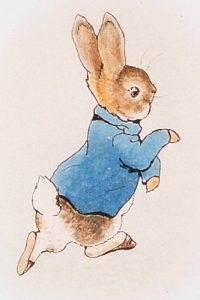
The rabbit was, of course, Peter Rabbit, and the postcard was of Beatrix Potter. But Martin, the host of the Churchwalk B&B, had much more to say. Embarrassingly I must admit that I knew generally little about Beatrix Potter other than she wrote children’s literature but little else. Well, Beatrix Potter was much more than a children’s author. In five minutes, I learned from Martin just how much more. She was a woman of incredible strength who defied the gender norms of the time, she used her acquired privilege to pursue science, agriculture, and conservation all with a goal to make the world, especially her part of the world, the Lake district better. Her ethics display a love of place that moves beyond the emotional attachments of love to action

Not only was I so happy to have asked, but the respect for Beatrix Potter’s contribution and her love of the Lake district was palpable in Martin’s answer. And this I realized is an experience that is so unusual in modern tourism as so much of the interactions we experience as we travel are transactional. As I started my walk, that breakfast conversation lingered with me.
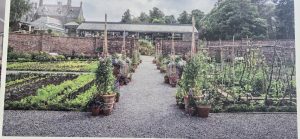
Walking with Wordsworth
Of all the people who most made the Lake District well known, is the poet William Wordsworth. But after our talk, I needed to add Beatrix Potter to the list. As I finished my first day walking 25 km from Ulverston to Coniston, I passed the John Ruskin elementary school, suddenly realizing that Ruskin lived here and I needed to add another name to the list of people that shared a deep love of the Lake District. Wordsworth and Ruskin are two authors who have touched me beginning in my later years of high school, through university, and on into my teaching years, but perhaps more importantly is that these writers, particularly Wordsworth, spoke of nature and transcendence, an idea that captured me as a seventeen old and never really left. Being in nature has always created that sense of peace and joy in me that always feels more elusive to me when I am in society. Wordsworth’s Lines Composed a Few Miles above Tintern Abbey capture this perfectly:
…I have felt, A presence that disturbs me with the joy,
Of elevated thoughts, a sense of the sublime,
Of something far more deeply interfused.
The joy and awe that nature creates in me reminds me of what I felt as a child looking over Lake Huron and its wild waves after a storm. John Ruskin’s recounting of one of his early childhood memories of being taken to the “brow of Friar’s Crag on Derwent Water; [and feeling] the intense joy mingled with awe, that I had looking through the hollows in the mossy roots…” resonates with my younger self. And even today, decades later, when the light is exactly right, or when I feel one with the landscape under my feet I can still glimpse into the divine.
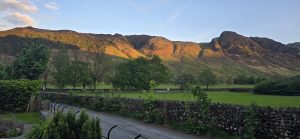
With each step that I was taking along the Cumbria Way, the beauty of the landscape, and what they wrote began to cause a stirring in me to question what linked these authors. I began to think that it was not just the beauty that created this love, but perhaps that there was more going on; perhaps a reciprocity was occurring. In the words of Robin Wall Kimmerer there is a “grammar of animacy,” where our view of nature or a region becomes not an “it“ but a “who.” And in doing so, we enter relationship. Martin spoke of his Lake District, not just as a place where he lives, but as a place where he was in relationship with its past, present and future.

Ancient Ways of Understanding Relationship with place.
This feeling of being in relationship with nature is not new. Drawing on my Scottish, Welsh, and Irish roots their ancient languages have words that describe a world from a totally different point of view. Scottish Gaelic has a word that tries to capture this connection to landscape that at its core is untranslatable into English. The word Dúthchas captures both the interconnectedness and the collective responsibility that links land, its people, culture, and history. Just as our indigenous peoples did not view land as a commodity so too did the Gaels, who saw land as communal to which people belonged. With that comes the obligation to have intergenerational custody to preserve that space.
What’s love go to do with it?
Defining and articulating what love is and all the ways it can manifest has occupied us humans from philosophers to songwriters for a long time. But the focus has almost exclusively been on the interpersonal. Yet, the idea of love of place is at one level not a particularly novel idea as many of us have our favourite places and we may use the word love to describe our affections to that place, and those affections move one to action.
Interestingly, Thomas Aquinas writing a millennium ago, provides a framing that allows me to start to understand the complex emotions that I feel as I continually find myself drawn to the natural world whether through vocation as a former organic farmer or as a hiker.
Aquinas in his work, Summa Theologie he described two types of love, amore unitivus (unitive love) and amore amicitiae (contributory love). Unitive love, according to Aquinas, is beyond the emotion of love for another person, to one where one feels there is a connection between themselves and their beloved. Contributory love is where love begins to become an action where the lover wishes to “will the good of another.” The lover can contribute to increase the good of another. He argued that both types of love act in tandem.
And I wondered, is it possible that love of place, love of a region, love of a community can follow the framework suggested by Aquinas. First, by creating an unitive connection with a place it creates a space where now it is possible to contribute to the good of the place that you love. This action that translates into praxis that instead of coming from a place of shortage comes from the infinite capacity we have to love.
In an era that is characterized by eco-anxiety or solastagia, as psychologists now term the anxiety they see caused by the stress, and grief caused by the destruction of people’s home environments, and the globe at large, can the acknowledgement that a human can love a place move us from the existentialism and nihilism that seems to paralyze us in moving towards action.
So, What does contributory love look like in a practical sense?
It is easy for me or others reading this prescription, to thinking these steps are simple. It requires us to move beyond attachment, a practical dependence and nostalgia we may have toward a place. Tyler J. VanderWeele, who studies human flourishing asks necessary questions such as: “How does this place define me? How can I make this place flourish?”. The answer to these questions, will define what your contributory love will look like. Your heart knows what is needed to make a place flourish, just as I know when your beloved or your child needs a hug.
Contributory love of place leads to active emotional and moral stewardship anchored based in love of nature, humankind, and with a sensibility that is communal and naturally reciprocal. At its core, it will be non-transactional characterized by altruism. Engagement and participation will most often be at the neighbourhood, urban or regional scale. Underpinning this protection and engagement is the sense that regions, places, and communities need the same as we want for our human beloveds. Their rights are sacred and grounded in love. When we are able to make that subtle shift that places have rights and need to be loved we can start to make places close to our heart flourish.
As Mark Twain has remarked, travel opens one’s mind. Thanks to Peter Rabbit, Beatrix Potter, and my host Martin and my walk in the Lake District, this aphorism rings true.

A most enjoyable deep dive exploring love of place, love of community. Thank you Jamie for sharing your thoughts on this meaningful topic. May your ideas spread far and wide to uplift us all.
Thanks Michele. I am glad you enjoyed the post.
Jamie, this is such a good reflection. When I think about community development, I’m always struck by how the word community carries both social and geographic meaning. We are shaped by the people around us and by the places we inhabit, and we have the opportunity to nurture both.
I especially appreciate the idea of moving our understanding of place from an it to a who. That shift sparks a deeper sense of responsibility and care for the ground we walk each day and the people that call it home.
Thank you for sharing your learnings from the north of England. You’ve inspired me to start planning my own trip deeper into the Lake District!
Thanks Clayton I am glad you enjoyed the post. Not mentioned in the post specifically is an idea that has been popularized by Robert MacFarlane’s recent book “Is a River Alive” which introduced me to the idea that if we consider something in nature such as river being “alive”, then we are in relationship and from that the idea nature has rights. This concept is not foreign to indigenous people by it is still pretty controversial in our society but may be the key to understanding communities and nature.
Walking, although an intimate type of travel, unfortunately does limit what one can see in a day. There is much to see and do and it definitely is worth a deeper exploration.
Jamie I thoroughly enjoyed your reflection on place; drawing us into the conversation of exploring place as something animate and deserving rights. It reminded me of the work of Alderville First Nation’s ability to have the rights of personhood granted to Rice Lake: “ Legal Personhood for Rice Lake (Pemadeshkodeyong): In a landmark move, Alderville First Nation granted legal personhood to Rice Lake. This makes the lake a “living relation” with inherent legal rights, including the right to exist, thrive, regenerate, and be free from pollution. Enforcement is managed via a newly established Guardians Council, which gives the ecosystem legal standing in court.”
If we lived in a place where indigenous worldview was dominate, such legalization wouldn’t be required, it’d be inherent.
Jamie your reflections on place also reminded me of a chapter called ‘Uprooting Colonial Conservation:Returning to Kinship” I read in the book “Power With”. In that chapter Georgian Bay Anishinaabek Youth teach about the animacy of a canoe which they built together. It is clear the canoe is a being deserving of love and respect ; deeply a part of each of them. She is named and honoured.
Finally, reading any of Quill Christie-Peters words resound with your expressions of loving place intimately in order to be motivated to action. She believes homelands are more than just physical places we come from; “ they are our bodies , our ancestors, our story and song embedded in River and Rock.”
Who wouldn’t be moved into action to save our ancestors, stories , songs… our essence?
Thank you for inviting us into thinking deeply about connection to land!
Pam I am glad you enjoyed the post. I wasn’t aware of the Alderville’s First Nation success in granting personhood to Rice Lake. You are so right, if we could encompass more of indigenous world view these rights would be inherent. What I didn’t mention in the post is how the Welsh language is similar to our indigenous languages in that they are both less “noun” centric” which creates a natural duality between us and nature where nature is seen as an object to be manipulated.
I love that!!! I’m interested in looking into that. I wonder which other nation have language that is similar and if it reflects a cultural belief system where all of nature is equal to us two legged!!!
Can’t wait to read your next post.