
Walking in the steps of my ancestors
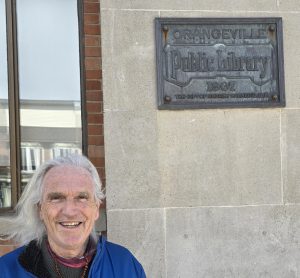
The act of walking is an intimate experience. In a world where everything seems fast, walking is slow. In that slowness, there is time and space that is different from our everyday life; to exercise, a time to think, to remember, to plan, and often, a time to be in the moment feeling your feet touch the ground and to take in the space that you are walking in. For me, walking encompasses all those things.
Some of my walks are intentional. They are pilgrimages, sometimes with a goal in mind, but often an exploration of what will arise as I walk. My fascination with liminal space has taken me to walk borders wondering how these borders have defined the identity of the people who live(d) there. Walking the length of the Welsh/English border and the Scottish/English border has highlighted that my family that lived along these borders, carved out a unique identity that allowed them to live along a constantly changing frontier.
The identity that emerged hundreds of years ago in Scotland and Wales is like looking through a darkened glass; some shapes are present but lost are the details in the mists of history. I still feel that my conclusions remain tentative but here in this blog I turn my attention to something more recent and closer to home.
Looking Closer to Home
Sometimes serendipity makes me wonder if there is another force at play that goes beyond our understanding of why things occur. This story connects a book from a history project from high school, field trips I led as a high school teacher, the founding of Orangeville, a Carnegie library, a hotel, and ultimately my family. The beginning of my understanding of this story is 50 years old, but the final pieces have only fallen into place recently. And yet it offers a tangible glimpse that connects the more recent past back through that darkened glass of events along the Scottish borderlands hundreds of years ago.

The book in question, The Yellow Briar by Patrick Slater( John Mitchell), was assigned to me to read in grade 13 to do a report on pioneer life in Ontario in the 1840’s. I fought vehemently against being forced to read this but as you can imagine the power dynamics in high schools in the 1970’s meant I lost. Fast forward twenty years, and I am living on the same line as where the author lived and based his story. I will eventually be involved in the restoration of the old church which was adjacent to where the author lived.
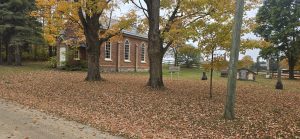
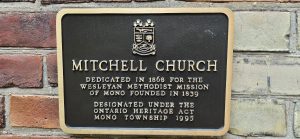
Towards the end of my career, we undertook a curriculum review and decided to introduce the local history of the growth of Orangeville. This involved local field trips where we took the students out to see how and where Orangeville developed. Our starting point was always the Orange Lawrence mill built in the 1840’s, a time when this area was the frontier of Upper Canada. On our tour we included the downtown which was mostly rebuilt after 1871, as a fire had destroyed the downtown. On one of our stops, at the site of the Carnegie library, I always explained that before the library had been a hotel, one of the buildings destroyed.
And then suddenly, this story starts to become personal. As I find out more my roots, I have discovered that my great uncle George Bell lived in Orangeville in the 1850’s. I filed that away as interesting as I was more focused on his brother who was my great grandfather. Then, while reading local historian Wayne Townsend’s, Orangeville: The Heart of Dufferin County I read about George Bell and that he once owned a hotel on the present location of the Carnegie library. Wow! Suddenly I feel that I have been part of this story all along and it is now my responsibility to tell this story.
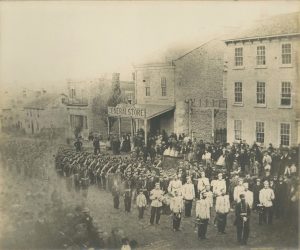
I am still wrapping my head around that my family played a significant role in the growth of Orangeville. At the time Orangeville was small, close to eight hundred people, but like the founder Orange Lawrence, George Bell saw the potential of this small town on the edge of then frontier. His hotel served as Orangeville’s town hall, and it is in the hotel where decisions to shape the history of the town occurred. I have found little information on George’s wife, Anne Jane Armstrong, but with the help of the local museum they think her family lived in Mono the township I reside in or the adjacent township of Amaranth. Hopefully, I can find out more about her family as well.
What is noteworthy, is that George Bell was the first Bell to leave the family farm to pursue an urban occupation. His choice of moving to the then frontier of Upper Canada to take advantage of the rapid growth in a newly established settlement by building a hotel, created a unique business plan that will ultimately be copied by members of the Bell family as they will go on to open hotels across Canada stretching to the Saskatchewan border, following the growing frontier of Canada.
And it turns out that I did not have to walk far. Now when I walk the downtown of Orangeville, I belong a bit more to the story of where I live.