
The End of the Road as Queer Space
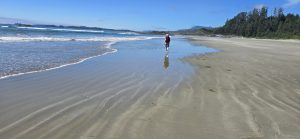
The end of the road as “queer space”
This blog post captures my thoughts I had while walking the littoral zone of Pacific Rim Park. A littoral zone is the place where ocean and land meet. It is quintessential liminal space that is constantly changing as the tides come and go daily, changing the nature of this zone.
This is the spot where one can walk barefoot, on solid ground but also be wet. I have always found this sensation to be both grounding and meditative.
In British Columbia, Highway 4 starts on the east side of Vancouver Island north of Victoria and it snakes slowly to the west side of the Island. When it reaches the coast at Ucluelet, it heads north through Pacific Rim National Park ending at Tofino. Highway 4 is the most westerly road in Canada stopping at the Pacific Ocean. As I parked the car to start my walk along the beach, the realization that I really could not go farther west, and I had reached Canada’s western frontier.
I find the idea of the end of the road as a flawed cliché that we often view as the point where nothing more is possible, a finality. Rather than seeing it as a endpoint perhaps we can reimagine it as a space where new opportunity and possibility opens up. The linear nature of a road is constrained, just as our life is often constrained by norms and beliefs. Nature does not do straight lines. We impose those boundaries on nature and ourselves. My love of nature is probably rooted in a sense that nature is intrinsically boundless, countlessly changing and opening up new cycles of life. In this worldview I can start to believe the end of something is often the start of a new beginning.
Pacific Rim National Park
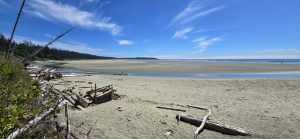
Long Beach is an end of the road. It is also one of Canada’s premier surfing destinations. Here a surfing culture developed with an identity that is outside the norms and beliefs of mainstream society. Here, the pursuit of the ideal wave may be mutually exclusive from the pursuit of material happiness.
In nature a shoreline is dynamic. Beaches are the natural result of this dynamism of the waves hitting land. So, in a sense, a beach is constantly reinventing itself. Its fundamental truth is change.
Although I have no surfers in my immediate circle of acquaintances and friends, I imagine surfers would understand that surfing allowed them to reinvent themselves just as waves cause a beach to reinvent itself.
Queer Space
As I walk along the beach, I ponder who are the people that are willing to remove themselves from the norms, routines, the geographic and familial roots to move literally to the end of the road. I have always seen myself as person who needs to be rooted in place, a person who is rooted in habit and familiarity. But am I? A critical interpretation, that shuts down that exploration is to judge that this is a type of escape from a life one is living. I could also imagine it could be a pilgrimage, a chance to reset and contemplate life’s challenges and directions before returning to their life. These impulses capture my thoughts as I walk the beach. Yet, I keep coming back to how this space at the end of the road is a frontier that is metaphorically at the edge of civilization. What is it like to choose to live on the frontier and the margins of society to be true to oneself.
One of the traditional views of the frontier is one of chaos, where the norms of civil society are not yet in place. The Moss Eisley Cantina in Tatooine of the Star Wars saga captures the fears of living in a place where normal rules do not apply. But it also where Han Solo and Chewbacca meet Luke Skywalker and Obi-Wan Kenobi that sets the direction, plot and dynamic of the story. It is a place where important things happen far away from the centre of the Star Wars Empire.
On this Canadian frontier, beyond the surfing community, we find artists, environmentalists, a thriving LGBTQ+ community all creating a unique space within Canada. Each of these groups, each in their own way, are questioning and living beyond the normative rules of society. There is a palpable sense of tolerance and affirmation of this diversity that is the hallmark of queer spaces.
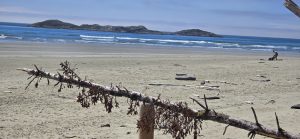
The end of the road is dynamic, like the beach, as it reinvents itself. Here I can see myself doing the same.
.