
Who were the good guys? bad guys?
The moral ambiguity of the Scottish English borderlands
This is a story where one can not easily divide groups of people into good guys and bad guys. For those who are fans of the show, Peaky Blinders, it is like diving into the world of Thomas Shelby, the leader of the criminal gang, who is the ultimate anti-hero. Determining right from wrong is difficult for us to do, as everyone carries both noble traits but also traits that are hard to reconcile.
When this reconciliation relates to your family history things get interesting. It is like diving into examining your shadow, or your darker side, a part of you that you really do not want to own. The traditional story of immigrants moving to North America to better themselves economically or to avoid persecution paints an uplifting story. Yet even with this typical story it never is that simple. The Bells in our family may well have been reivers. For some of us reading this, the reaction may be “cool,” this is interesting. For others, the reaction may result in embarrassment that we may have been criminals. So, this story, although no one member of our family is explicitly complicit in any of the unsavory things that occurred in this era, the Bell family were shaped by these events. Their ability to survive a frontier which was dangerous and where violence was common gave them the tools to survive as pioneers of the frontier of Canada but also allowed them to thrive.
What life was like in the 1500’s in Scottish English borderlands was not on my bingo card. In fact, even as a historian this time held little fascination with me until now. Vaguely, a period of transition between what we call the Middle Ages and the modern era, where I knew the broad strokes of history: the Protestant reformation, the beginnings of European colonialism, the relative decline of Spain against the beginnings of English ascendency, and the Copernicus revolution placing the sun at the centre of our solar system. Big events for sure that I dutifully taught over the years.
But I sure never wondered about the importance of the Galloway horse and its utility in raiding or the use of Pele towers to protect oneself and family from raiding. Staying in a farmhouse built in the 1500’s complete with a tower to protect them from the Scottish reivers suddenly made this history less abstract and way more personal. During my walk through Northumbria and Cumbria I became aware of the remarkably unique dialects of this region leaving me to wonder about what was the language like during the 1500’s. I became aware of a vocabulary of words that can be traced back to the events that occurred in Scottish English borderlands.
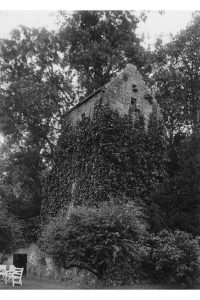
The need to protect oneself is evident on both sides of the border as families built Pele towers, a form of mini-castle, to shelter in during a reiver raid. Here is Blacket tower, a Pele tower associated with the Bell family. Built sometime in the 1400’s it was destroyed by the English in 1547. The ruins still exist today and if you wish you can stay in the Blacket House B and B!
Words tell us about a culture.
The ancient kingdom of Northumbria encompassed the area today we know as the Borderlands. The language spoken is primarily Anglo Saxon in nature so Germanic in origin, as well as a mix of Old English, Gaelic, and Norse. Words are a snapshot into a world view and here is the Border Reivers’ contribution:
Reive/Reiver: to rob or plunder/a person who robs or plunders.
Red-handed: a term that describes a person caught in the act of stealing cattle or livestock, punishable by immediate execution
Hot trod: (root of “hot to trot in current usage): within 6 days it was lawful to pursue the person or thieves and your stolen property. The significance of the term hot trod was because the pursuer would carry a lance of burning turf to announce that this was a legal pursuit. There was also a plausible deniability at play here as this allowed a person to cross the border between Scotland and England on the premise that livestock may have wandered away and this was not an invasion. In addition, a neighbour who refused to assist was an act punishable by hanging.
Blackmail: Protection money received through extortion
Bereave: to suffer a loss of property through theft (this word later transformed into a loss of a family member)
Lift: to steal (the word shoplift originates here)
This is a brief list and very selective, but it does point to a set of words that begins to tell us what was going on in this region of Scotland and England. Obviously, all these words relate to a degree of criminality and violence. It is easy to pass moral judgement and assume that this alone tells us what these people are like. It is extremely easy for humans to use our values today and extend them back in history. Five hundred years ago, society was more violent but even then, that does not mean that all members of society were perpetrators of that violence, but undoubtedly this violence shaped society. Next up we need to dive into the context and see how we would not have enjoyed living in this period.