
Lost words: lost meanings
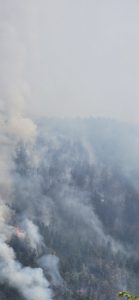
As I struggle to make sense of the wildfires consuming our boreal forests, I feel a frustration that I am at a loss for words to describe how I feel. This English language idiom, of being “at a loss for words” reveals a much deeper truth about language as words don’t just describe the world, they also build the walls of it. In the 1500’s the phrase described when the hounds would lose the scent of the prey and became more a metaphor for confusion or helplessness in the 1600’s. Adding “for words” to the phrase hints at an inability to find the correct words due to shock or surprise at a sudden turn of events, which is an accurate description of what I am feeling as I am trying to put the wildfires in context.
The Colour Blue
Within the field of linguistics, the idea of linguistic relativity forces us to reexamine that words are a fixed way to understand the world. In a landmark study, Brent Berlin and Paul Kay studied how colour names evolved in languages around the world and found that blue was the last colour to be named. They found that colours evolved in relation to the physical interaction with objects in nature that humans could manipulate through dyes, clothes and manufacturing. Even though water and the sky are blue, there are few physical objects that are blue. The ancient Egyptians, did have a word for blue, as they had developed a blue dye but otherwise the colour blue was the last colour to be named.

From this and other studies, linguistic relativity suggests that without a word humans have difficulty sorting and categorizing. Words not only label our world, but they also construct or build our world. The vocabulary we develop will ultimately dictate how we perceive time, landscapes, our identities, relationships and emotions.
Gendered languages tell us a lot about how words shape meaning.
In many languages nouns are gendered which as an English speaker having to learn French in school left me in a perpetual state of confusion. But what is fascinating is that the gendered noun creates a very gendered set of adjectives associated with that noun. In a study by psychologist Lera Boroditski et. al, they asked German and Spanish speakers to think of three English adjectives that described the objects. In German a key is a masculine noun and the adjectives used to describe the key included: hard, heavy, jagged, metal and useful while the Spanish speakers described key which is a feminine noun as: golden, intricate, little, lovely and shiny. Similarly, bridge is a feminine noun in German and its adjectives included: beautiful, elegant, fragile, peaceful and slender while the Spanish speakers’ adjectives for the masculine noun bridge included: big, dangerous, long and strong. The differences in meaning people ascribe gendered nouns is stark. I would argue that this is not simply the result of gendered nouns creating a distinct set of adjectives, but this is something we humans do with all words. We imagine a word describes an objective reality, but our minds begin to add adjectives, values and judgements that begin to shift meaning to be more subjective than we realize.
Lost Words
If words are how I create meaning, and I have plenty of words in my vocabulary, why I am left with the feeling that “I am at a loss for words” to describe how I feel about our forest in flames?
I know there are lot of words that are not useful.
improvement efficiency trespass ownership timber stock
title deed real estate crown land profit natural disaster
fuel loads fuel reduction suppression duty to consult
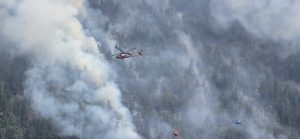
These are the words that we may use discussing forests, consistent with our current world view, but they all in their own way partially contribute to the current crisis (see Notes 1). But if we look back, these words were part of a linguistic displacement by a more dominant power, of older languages that described a view of forests as an intersection of land, people, and culture. This new vocabulary is transactional and extractive, underpinned by a belief that a society was made up of individuals rather than a collective and the natural world is an object. The old words are outlawed, considered obsolete or forgotten by the colonial powers, leaving the colonized with no conceptual language to be able to defend their homeland. And it is this loss of a conceptual language to describe the emotions I feel as our northern forests burn. Instead, a new language has been put in place. In our modern age it began with words such as the highland clearance and enclosures in Scotland and Wales and continued with words such as assimilation of the Indigenous people of the Americas.
The loss for words I feel about the wildfires is the direct result of the disappearance of words that connected humans differently to the natural world. The solution is to personally and collectively reclaim those words.
I have turned to the old words of my ancestors to look for clues; even though I have no fluency in those languages, I keep finding words that help me reconceptualize the world. What is reassuring is that these words are appearing again in response to the many crises of the modern world. Lost but not forgotten.
Cynefin (Welsh) (kuh-nev-in)
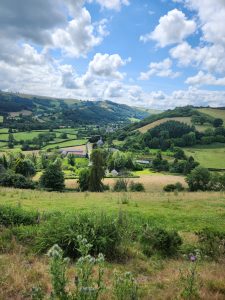
There is no direct English translation of this word, but it speaks to the interconnectedness that a person experiences between the physical, cultural and spiritual aspects of a place. Landscape creates identity and your understanding of reality; one does not live on land but is part of the land.
In 2022, Wales revamped their education system to incorporate cynefin throughout the curriculum thus reclaiming a word that had been forcibly erased in the “Welsh Not” era that physically shamed students for speaking Welsh. A student caught speaking Welsh had to wear a wooden board, saying “Welsh Not” around their neck. In a form of tag, the student could pass the board on if they caught someone else speaking Welsh. At the end of the week, the student left holding the board was subjected to further punishment.
By introducing the concept of cynefin to the Welsh curriculum, it is hoped to create a sense of identity and pride among the youth, particularly stressing the importance of place. The creation of a sense of belonging to a particular place not only addresses the mental health issues of powerlessness and anxiety so many people feel in our modern society, but it also allows people to realize that local nature is an extension of their identity. Therefore, caring for the environment is not an abstract idea but a natural extension of who we are.
I think all of us feel this type of disconnection as we watch our forests burn. Political leaders will often take a human tragedy and frame it around our national identity. When the tragic accident involving the Humboldt Broncos hockey team occurred, our leaders framed it as a national trauma. The prime minister declared, “the Humbolt community is emblematic of what it means to be Canadian,” which translated into collective response nationwide. Our political leaders tend to not speak of environmental issues as being an identity issue, which makes sense as our modern world has disconnected humans from the physical, cultural and spiritual connections we have with the natural world. If they did, and if we could use words such as cynefin to describe the world we want, what would our policies relating to our forests look like?
Duthchas (Scots Gaelic) (doo-chuss)
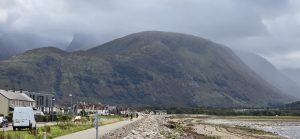
This word at a general level describes the social contract that existed in the Scottish Highlands between the clan chief, the tenants and cottars that believed in the inherent right of members of the clan to live on and rent ancestral land. It is also a cautionary tale of how political events can quickly destroy a social contract.
After the Battle of Culloden in 1745, the English government stripped the basis of power and economics from the clan-based culture of the Highlands, setting in motion the Highland Clearances. The English role was structural, passing laws that set the stage where for the clan chiefs to survive politically or economically, they needed to evict the tenants and cotters to move to a system of commercial monoculture of raising sheep. Those evicted moved to the growing industrial cities of Great Britain or emigrated to become part of the Scottish diaspora (see notes 2). For those evicted, this event not only destroyed their way of life but also their belief system that sustained it.
Looking at the etymological history of the word duthchas reveals a deeper philosophical connection to the land. Focusing on the prefix allows us to see how the Gaelic worldview is created. Linguistically, land and humans are linked to the Proto-Indo European word dhghom-yo. Just as the Hebrew name Adam relates to Adamah which means earth or land, duine (DOON-yuh) or person in Gaelic is one who comes from the soil. Du refers to the ideas of land or place where one lives. Duth expands into the idea of a natural order or birthright, and this connects to a specific piece of land. Finally, “chas” of “duthchas creates the sense of belonging to the earth or land of your ancestors.
Similar, to the Welsh word cyenfin, duthchas has reemerged in modern day Scotland as a movement to introduce land reform in a place where now a small group of elite and corporations own huge tracts of land in the Highland. Duthchas also reintroduces the concepts of an ecology that is more communal and traditional to counter our ideas that land use needs to be productive and efficient. A “placed” or a “kin based” way of knowing fundamentally changes the relationship between us and the land.
As I contemplate how these two lost words drawn from the languages of my ancestors teach me a new way to look at our world, I am left in a liminal space between knowing that physically, intellectually and spiritually I am connected to the land but knowing that our language needs to reclaim those concepts to be able to feel and express this truth.
Notes
- The role of fire in forest ecosystems. I have glossed over the natural role of fire in maintaining forest ecosystems. Fire is a natural occurrence and is necessary for the regeneration of forest. Our forests today are managed to suppress fire to preserve the commercial value of the forests. This practice means that when there is a fire, there has been a buildup of “fuel” that leads quickly to a wildfire which is seldom seen in nature. Our replanting of forests tends toward commercial species so there is little diversity which during a wildfire results in fires moving very quickly along the crown of the forest. On top of this, the boreal forest is adapted to a naturally cool, wet climate, something that is changing rapidly due to climate change which means our forests are under stress. Lightning becomes a major issue in the causation of fire.
- The Highland clearances. I have given a very short summary of the Highland clearances not to diminish the process that occurred, but in this case, I wanted to focus on the role language can play in understanding what happened.
- My section on the linguistics of the word duthchas has been helped by the work of Susan Chiblow and Paul J Meighan and their work comparing this word to the world of the Anishinaabe. “Anishinaabek Gilenedaaswin and Dutchas naan Gideal: concepts to (re)center place-based knowledges, governance and land in times of crisis” Ethnicities Volume 24, Issue 4.